Kingfisher Building Products, a UK coatings manufacturer based in Ulverston, Cumbria, has published plain-English guidance explaining when damp proof paint is appropriate and when homeowners should not paint over untreated rising damp.
The guidance arrives as winter heating and closed windows raise damp and condensation queries across UK homes. It sets out how liquid damp-proof paint, also called a liquid damp-proof membrane or liquid DPM, differs from damp-seal aerosols and anti-condensation paint, and why the three are not interchangeable.
Damp proof paint is a liquid-applied membrane that dries to a moisture-resistant film. Unlike decorative masonry paint, which is typically breathable, it is formulated to contain residual moisture and isolate salt staining so internal finishes have a sound surface to decorate or plaster over. Kingfisher’s guidance stresses that it is a supporting measure within a wider damp or waterproofing approach, not a standalone cure.
Used correctly, it can help with residual damp while walls dry after remedial work, with historic damp marks and salt staining once salts are treated, and as a secondary internal barrier after external defects that caused penetrating damp have been repaired.
It does not replace a damp-proof course. It does not stop structural water ingress from leaking masonry, failed pointing or cracked render. It is not suitable for untreated rising damp or for walls under constant water pressure, where a tanking system is usually required. Painting over active rising damp can trap moisture in the wall and make the problem worse.
Three products that are often confused
Confusion often starts in the DIY aisle, where similar-sounding labels sit side by side. Kingfisher’s note draws a plain-English distinction:
- Liquid damp-proof paint / liquid DPM: a brush- or roller-applied membrane for residual moisture and salt isolation after the source of damp has been addressed, or where moisture levels are already falling. Intended for larger wall areas; can sit under plaster, render or decoration.
- Damp-seal aerosols: typically small-area sprays used to blot or seal localised staining before emulsion. Not a structural damp solution and not a substitute for diagnosing rising or penetrating damp.
- Anti-condensation paint: coatings aimed at cold-surface condensation and mould-prone rooms. They address indoor humidity meeting cold walls; they do not cure rising damp or leaks from the ground or building fabric.
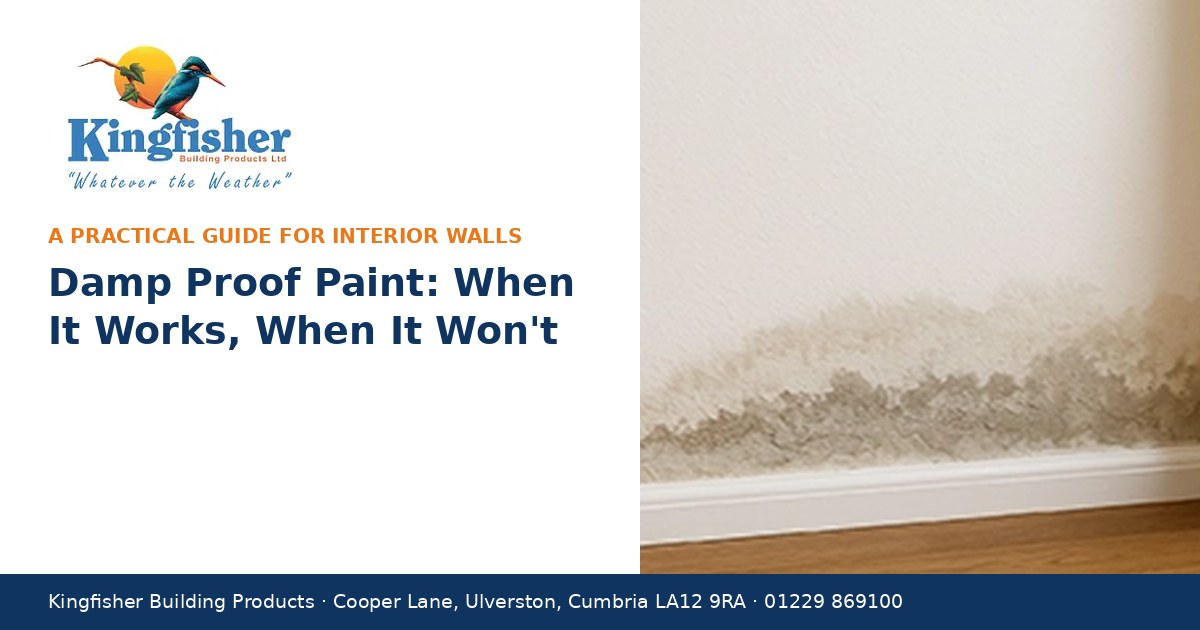
Tide marks low on a wall, salts on plaster, or patches that worsen after heavy rain usually point to rising or penetrating damp rather than condensation alone.
Find the cause first
Before any coating goes on, Kingfisher advises homeowners to identify the cause. Practical winter steps include ventilating when cooking and showering, drying washing in one well-ventilated room, keeping heating steady, leaving a gap between furniture and external walls, and wiping window condensation daily. Where rising damp is indicated, the damp-proof course and contaminated plaster need attention first.
Damp and mould can affect health as well as buildings. Government guidance on damp and mould, and directories of qualified specialists via the Property Care Association, are useful starting points for diagnosis.
Kingfisher manufactures Damp Guard damp proof paint at its Ulverston factory. According to the product data sheet, Damp Guard is a water-based, solvent-free styrene butadiene latex liquid membrane. It covers about 4 square metres per litre, is applied in two coats by brush or roller, and can be applied to damp backgrounds provided there is no glistening surface water. Once dry, it can be overpainted with emulsion or wallpapered. It is not a cure for rising damp or leaks.
The company’s full guide is available on the Kingfisher Building Products website, and free technical advice is available before purchase on 01229 869100 or office@kingfisheruk.com.
Kingfisher Building Products is not connected with Kingfisher plc or B&Q.
About Kingfisher Building Products
Kingfisher Building Products Limited manufactures paints, sealers, sealants, coatings and waterproofing systems, including damp-proofing products, in Ulverston, Cumbria. It supplies trade and public customers from Cooper Lane, Ulverston, Cumbria LA12 9RA. For more information, visit kingfisheruk.com.