
Scientists behind open letter to Nikon join live panel on AI in scientific imaging
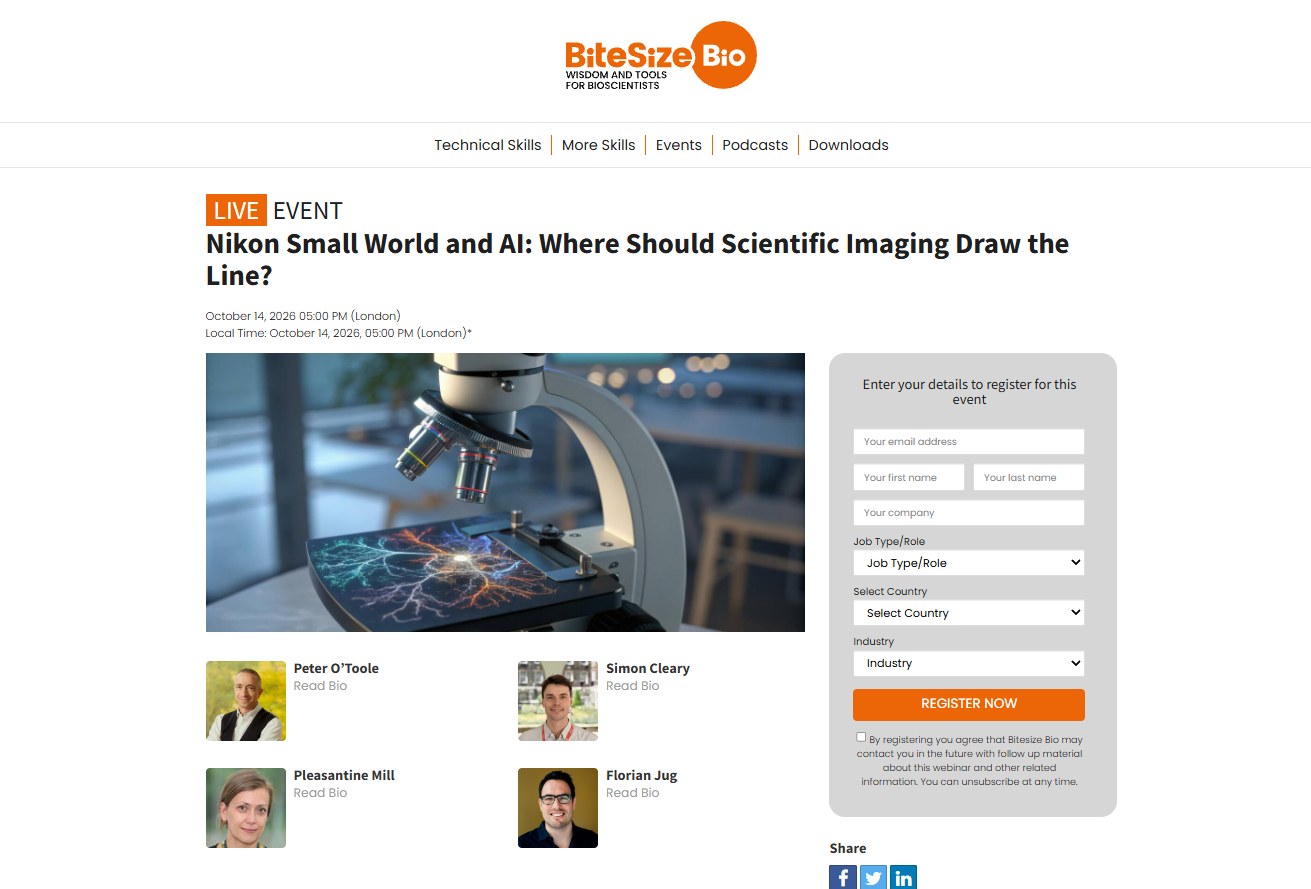
EDINBURGH, UK — 13 October 2026: Two scientists behind an open letter to Nikon and Dr Florian Jug, an expert in image analysis and biomedical AI at Human Technopole in Milan, will form a live online panel on Wednesday 14 October to debate AI use in scientific imaging. Professor Peter O’Toole will chair the discussion hosted by Bitesize Bio at 5 pm UK time (9 am LA, 12 pm NY, 6 pm Berlin). Since its release, more than 450 researchers, clinicians, and patient organizations have signed the letter.
What happened at 2026 Small World in Motion?
For more than 50 years, Nikon Small World has been a leading microscopy competition, inspiring the public with images and videos of the real microscopic world. Its video category, Small World in Motion, is now in its 16th year.
On 9 October, after three weeks of controversy, Nikon ruled that the original first-place video in its 2026 Small World in Motion competition did not comply with its rules on generative AI. After consulting members of its judging panel, it revised the rankings and said it would revisit its rules and evaluation procedures for future entries.
The video was captioned as showing abnormal beating of airway cilia from a child with primary ciliary dyskinesia (PCD), a rare genetic disorder. After it won in September, cilia biologists, microscopists and PCD clinicians questioned what it actually showed. The entrant has said AI was used in post-processing, but not to generate the cilia or their motion.
The Open Letter to Nikon in Response
On 5 October, Professor Pleasantine Mill, a cilia biologist at the University of Edinburgh’s MRC Human Genetics Unit, posted an open letter to Nikon from the PCD, cilia, and microscopy communities. Fellow panelist Dr Simon Cleary, whose research group uses microscopy to understand lung injury and repair mechanisms at King’s College London, was among the first group to comment on drafts and sign the letter. More than 450 signatures is a large number for the relatively small research communities working on a rare disease and video microscopy.
The letter is addressed to Nikon rather than the entrant, asking them to release the original recording and full methods for independent examination, publish the outcome of its review, and set clear rules on AI and image processing for future competitions. Its authors stress that they are not against AI in imaging, which already does much of the work of denoising, segmenting, and reconstructing microscopy data.
Mill said, “We are not against AI. In rare diseases like PCD, it is already helping us find and diagnose patients, and in microscopy it is a reliable workhorse. Every image in a competition like this is processed, and false color is expected. The line we draw is not between raw and processed images, but between transforming what was recorded and generating what was not. We use microscopes to capture the real world, never to create it.“
She continued, “This was not just another ‘art competition’, but a renowned and revered microscopy institution. Advancing technology has dramatically changed what can be done post-acquisition, much of it for the better. But more concerningly, it can now create images loosely based on real ones, with no microscope required. Our guidelines, and possibly guardrails, for AI in microscopy forums need to keep up with rapidly evolving AI capabilities, and we need to bring everyone along with us. This timely case shows how far behind we are.“
The Live Panel Discussion
O’Toole, President of the Royal Microscopical Society and Head of Imaging and Cytometry at the University of York, will chair the panel discussion on Bitesize Bio. The panel also includes Dr Florian Jug, Head of Research, Multimodal AI Across Scales, at Human Technopole. Jug has developed AI methods for microscopy for over a decade, including the widely used CARE and Noise2Void, and now builds AI that connects imaging with other biomedical data, from molecules to patients, with a focus on models that report how confident they are.
Together, the four panelists will discuss how to distinguish useful enhancement from generated detail, how researchers can document and validate image processing, and how shared guidance could support researchers, reviewers, and imaging competitions.
Dr Nick Oswald, Founder and Director of Bitesize Bio, said, “Microscopy images are data, and researchers need to be able to trust them. AI is now part of almost every imaging workflow, so the question isn’t whether to use it but how to use it openly. We wanted to give the microscopy community a space to work out what good practice looks like, with the people who raised these questions and the people who build the tools.“
Journalists are welcome to attend the event and can register for free here.
Event details
- Title: Nikon Small World and AI: Where Should Scientific Imaging Draw the Line?
- Date: Wednesday 14 October 2026
- Time: 9 am LA | 12 pm NY | 5 pm UK | 6 pm Berlin
- Format: Online Panel: Free to attend, on-demand recording available
- Chair: Professor Peter O’Toole, Royal Microscopical Society and University of York
- Panellists: Prof Pleasantine Mill (University of Edinburgh), Dr Simon Cleary (King’s College London), Dr Florian Jug (Human Technopole)
- Registration link: events.bitesizebio.com/nikon-small-world-and-ai-where/join
Notes to editors
About Bitesize Bio (Science Squared Ltd): Bitesize Bio publishes practical articles, webinars, and podcasts for life science researchers, including The Microscopists podcast hosted by Peter O’Toole. You can visit their website at bitesizebio.com
About the panelists
Professor Peter O’Toole is Director of the Bioscience Technology Facility and Head of Imaging and Cytometry at the University of York, and President of the Royal Microscopical Society.
Professor Pleasantine Mill is a Professor of Cilia Biology and MRC Investigator at the University of Edinburgh’s MRC Human Genetics Unit, and Co-Director of the LifeArc Centre for Rare Respiratory Diseases. She coordinated the open letter to Nikon.
Dr Simon Cleary is a Lecturer at King’s College London’s Institute of Pharmaceutical Science and Centre for Lung Health, with experience in video microscopy.
Dr Florian Jug is Head of Research, Multimodal AI Across Scales, at Human Technopole in Milan, Italy.
Media contact: Zara Puckrin, Marketing Manager, zara@bitesizebio.com, +44 (0)7593 699531
news via inbox
Sign up to our newsletter to receive the latest news straight to your inbox
